
Every organization's strategic priorities rest on a set of dependencies outside of its control. A utility seeking commission approval for a multi-billion-dollar rate case depends on regulators who exercise independent discretionary judgment. A developer pursuing siting clearance depends on community groups whose posture reflects concerns the developer may only partially understand. An organization seeking to hold a legislative coalition together depends on elected officials who answer to constituencies the organization cannot reach through internal channels. The rate increase is granted or it is denied. The infrastructure asset gets built or it does not. The coalition holds or it fractures. In each case, the proximate cause is the behavior of independent stakeholders — regulators, communities, elected officials, coalition partners, institutional investors — whose decisions the organization can influence but can't dictate.
This is not a circumstantial feature of the utility sector, or of the current regulatory environment or of the political moment. It is the structural condition that Jeffrey Pfeffer and Gerald R. Salancik formalized in their foundational work on the external control of organizations.[1] Organizations are open systems. They depend on external actors for resources, for legitimacy and for the conditions necessary to pursue strategic objectives. Because these dependencies are unevenly distributed, external actors can constrain organizational discretion — and because coercion is unavailable, organizations manage that constraint through influence: through credibility, exchange and the careful management of the dependence relationship itself.[2]
R. Edward Freeman's canonical stakeholder definition follows from the same structural logic: a stakeholder is any group or individual who can affect or is affected by the achievement of the organization's objectives.[3] The definition is intentionally broad because the reality it captures is broad. Managing the stakeholder relationship is not a support function; it is the management of conditions under which objectives become achievable.
The dependence is well understood as a structural condition. The more consequential question is whether organizations are managing it with the discipline the condition demands.
In most large organizations, the answer is that they are not — not because the people doing the work are undisciplined, but because the organizational architecture is not built for it.
Consider how this work actually runs inside a mid-to-large investor-owned utility. The work sits under an External Affairs umbrella and splits into two broad buckets: on the public relations side, Media Relations manages press coverage and the public narrative while Community Relations runs engagement in the field; on the public affairs side, Government Affairs maintains legislative, state and federal relationships while Regulatory Affairs prepares filings and tracks commission proceedings. The labels vary by organization; the pattern does not. Each function runs its own workflows, maintains its own contacts, records its own history in its own tools — a government-affairs CRM here, a shared drive of post-hearing debriefs there, a spreadsheet of stakeholder contacts that the person who built it carries in her head as much as on the server. When she leaves, the institutional memory leaves with her.
No single record connects the commission proceeding to the coalition-management work to the regulatory filing strategy to the community engagement program happening two counties over on the same project. The VP of External Affairs briefs leadership with a synthesis she assembles from four sources that do not share a format or a vocabulary. The rate case proceeds with each function's stakeholder picture incomplete — not because any function is failing at its job, but because there is no shared system.
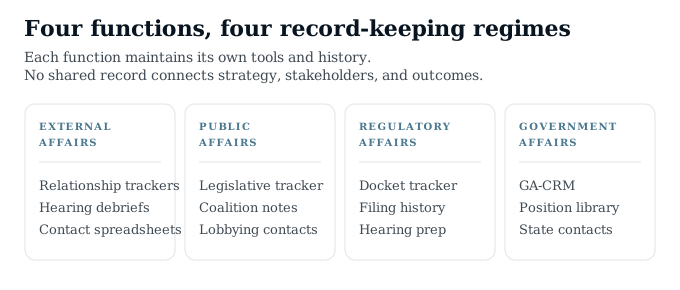
This is the governance gap: not a staffing problem, not a competence problem, but a structural absence. When looked at as a functional chain, there is a clear link between any strategy and its desired outcomes: stakeholder action. The reality, however, is that the workflows that determine whether stakeholders align with or obstruct outcomes are distributed across functional stovepipes, recorded in disconnected artifacts and retained in institutional memory that does not survive organizational change.
Practitioners in this space recognize the pattern immediately. Most of the tools that exist — government-affairs CRMs, media monitoring platforms, investor-relations systems, community-engagement databases — are each competent within their domain, but are not built around the strategy-to-stakeholder-to-outcomes chain. They are not a system. They are a collection of domain-specific solutions that the organization's people must manually integrate, repeatedly, for every project and every proceeding.
The result is a category error: organizations are trying to solve a dependency problem with tools built for functional work. It is the same error that once attached to every other major organizational dependency before it had a system of record.
Finance looked like this before the general ledger. Every transaction was recorded somewhere — in ledgers maintained by function, by region, by business unit — but there was no integrated record where the organization could see its complete financial position. The general ledger did not change what accountants did; it changed the organizational architecture around what they did. It made the distributed work of the finance function legible, auditable and strategically usable.
Risk management looked like this before the risk register. Individual functions identified and managed the risks they could see; no one held the integrated picture of what the organization was exposed to in aggregate. The risk register provided a centralized record of identified risks with assigned owners, tracked status and defined escalation paths. Risk did not become simpler; it became governable.
Supply chain management looked like this before enterprise resource planning. Procurement, inventory, fulfillment — each had its own records, its own optimization logic, its own blindspots to what the other functions were doing. ERP was the integrated record that made cross-functional visibility possible at the operational level. Security operations looked like this before SIEM platforms provided the centralized record of security events, correlated across sources and surfaces, that made coherent defensive action possible.
The pattern across each of these cases is consistent: distributed informal practice gives way to integrated systems of record once the discipline outgrows its informal phase. It does not give way because the distributed practices were wrong. It gives way because the organizational stakes get high enough that the cost of distributed practice — the lost context, the incomplete picture, the decisions made on partial information — becomes unacceptable. In finance, the stakes were fiduciary and regulatory. In risk, they were enterprise survival. In supply chain, they were operational continuity. The disciplines that are now externally governed carry their systems of record with them; the general ledger is not merely an internal tool but the foundation for external reporting obligations, audit requirements and governance accountability.
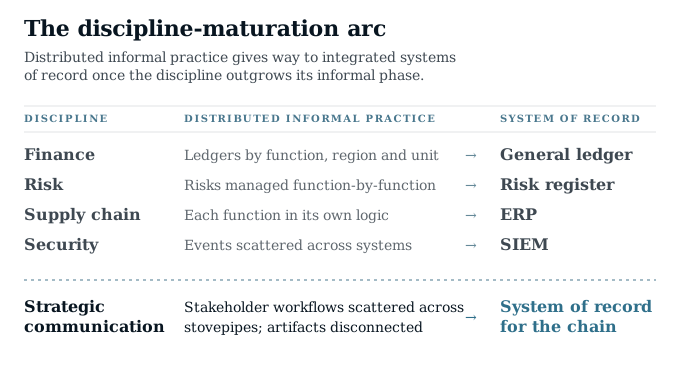
The strategy-to-stakeholder-to-outcomes chain is the next case in the same pattern. The organization's most consequential external dependencies are managed today the way finance was managed before double-entry bookkeeping became universal: distributed, informal and dependent on individual expertise that does not transfer. The organizational stakes are real — the rate case, the siting decision, the coalition, the legislative relationship — and the cost of distributed practice is already visible in the proceedings that turn against expectations and the projects that stall without a clear account of why.
What's needed is a new product category that addresses the need for strategy-to-stakeholder-to-outcomes chain governance. Thankfully there is an existing discipline upon which such a platform can be built — strategic communication.
Strategic communication (lowercase) is a mature academic and practitioner discipline. The discipline addresses how organizations understand and align stakeholders to take the actions needed to advance strategic priorities. It is not new, and it is not narrow.
Establishing a new Strategic Communication (capitalized) product category makes the most sense. Platforms in this category would operationalize the discipline, providing organizations with the centralized, logical governance of the strategy, strategic communication and operational workflows that produce clarity and unity of action across the functions whose combined work determines whether independent stakeholders align with strategic outcomes.
The adjacent platform landscape has not claimed this territory. Existing tools are strong inside established buyer domains: media intelligence, public affairs, investor relations, community engagement, stakeholder engagement, reputation monitoring. Some are narrow and domain-specific; others span multiple stakeholder contexts through intelligence, monitoring or engagement workflow. But their organizing logic is not the strategy-to-stakeholder-to-outcomes chain. They begin from a function, a stakeholder database, an issue stream, a communications channel or a monitoring layer. Strategic Communication requires a different architecture: one that starts with organizational strategy, connects it to the independent stakeholders whose actions determine outcomes and records the workflows that shape whether those outcomes advance or stall.
The gap is structural. Even where adjacent platforms now span multiple contexts, they did not arise from a theory of the cross-domain chain; they arose from the professional disciplines that organized each domain independently — PR, government affairs, investor relations, community relations — each with its own training, its own associations, its own procurement process. The software followed the buyers. No platform currently claims Strategic Communication as its category, because no incumbent is positioned to make the architectural argument that the category requires.
SCI — Strategic Communications Intelligence — is the first platform built to occupy this category. It establishes the strategy-to-stakeholder-to-outcomes chain as the organizational architecture: embedding strategic priorities, surfacing the independent stakeholders whose posture and behavior determine whether those priorities advance and optimizing the communication and engagement workflows that shape that posture. Its companion architectural distinctive is distributed ownership: the subject matter experts and practitioners across External Affairs — media relations, community relations, government affairs, regulatory affairs — and in the strategy and operational functions that sit alongside them each maintain the records that represent their piece of the chain. The platform integrates their work into a shared system of record rather than centralizing the people who do it. Logical centralization, not organizational centralization.
The strategic outcomes that depend on independent stakeholder action are won or lost in the space this system of record fills.
The failure mode is not unfamiliarity. The people who manage these relationships know their counterparts well; they are often among the most experienced practitioners in the building. The failure mode is architectural: when an organization's distributed stakeholder work runs on disconnected tools and institutional memory, leadership operates on an incomplete picture, decisions go forward on partial information and the vulnerability surfaces at the moment it does the most damage — in a proceeding, in a coalition, in a hearing room.
The case is not hypothetical. In 2021, the Pennsylvania Public Utility Commission denied Transource Pennsylvania's siting applications for the Independence Energy Connection, rescinded its provisional certificate and denied 133 eminent-domain applications after community groups, landowners, Franklin County and Pennsylvania's consumer advocate put updated congestion-cost evidence into the record. The project had been justified on one economic picture; by the time the proceeding was heard, civil society, local-government and ratepayer stakeholders had made a different picture decisive. The result was not a messaging failure. It was a governance failure in the strategy-to-stakeholder-to-outcomes chain: the organization needed regulator, ratepayer, local-government, landowner and regional-market alignment, but the evidence and stakeholder coalition moved faster than the organization's shared record of the project did.[4]
The discipline is mature. The category is new — Strategic Communication. The platform arrives last in every discipline's maturation arc — after the informal practices have proven insufficient and before the system of record they require becomes the infrastructure no successor generation would consider building without. Finance, risk, supply chain, security: each waited for that threshold. Strategic communication is crossing it now.
Notes
Jeffrey Pfeffer and Gerald R. Salancik, The External Control of Organizations: A Resource Dependence Perspective (New York: Harper & Row, 1978; reissued Stanford, CA: Stanford Business Books, 2003). ↩︎
Pfeffer and Salancik, External Control. ↩︎
R. Edward Freeman, Strategic Management: A Stakeholder Approach (Boston: Pitman, 1984). ↩︎
Pennsylvania Public Utility Commission, Opinion and Order, Docket Nos. A-2017-2640195, A-2017-2640200, P-2018-3001878, P-2018-3001883, A-2018-3001881 et al., public meeting held May 20, 2021, https://statepowerproject.org/wp-content/uploads/2023/12/pa-independence-connector-siting-decision.pdf. ↩︎